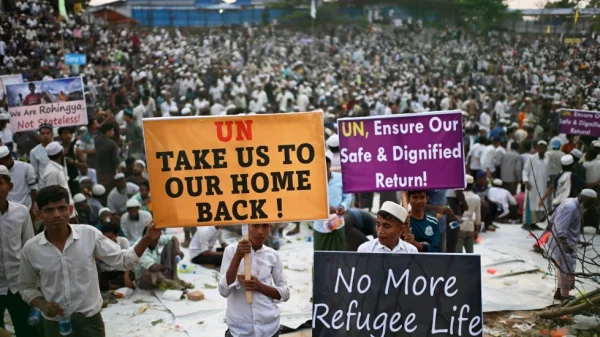
Severe reductions in international humanitarian funding have intensified risks facing Rohingya children living in refugee camps in Bangladesh, according to an in-depth investigation by The Associated Press. The findings point to a troubling rise in child exploitation, disrupted education, and weakened protection systems following sharp cuts to U.S. foreign aid.
More than 1.2 million Rohingya refugees live in camps around Cox’s Bazar, and children make up over half of that population. Barred from formal employment in Bangladesh and unable to safely return to Myanmar, Rohingya families depend almost entirely on humanitarian assistance to survive.
Funding Reductions Leave Children Vulnerable
For years, the United States was the largest single donor to Rohingya relief operations. That changed in January when the U.S. administration dismantled the U.S. Agency for International Development (USAID), significantly reducing overseas aid. As a result, U.S. contributions to the Rohingya response in 2025 were cut nearly in half compared to the previous year.
Overall, the Rohingya humanitarian appeal in Bangladesh is currently only about 50% funded, according to aid agencies. Relief groups warn that the funding gap is expected to widen further next year, threatening already strained services such as education, health care, sanitation, and child protection.
UNICEF, the United Nations children’s agency, reported losing more than a quarter of its funding following the cuts. In June, the agency closed approximately 2,800 learning centers across the camps, abruptly ending education for tens of thousands of children.
Sharp Rise in Abuse and Exploitation
The closure of schools and safe spaces has had immediate and damaging consequences. With fewer structured activities and protections, children have become increasingly exposed to exploitation and abuse.
UNICEF data show that between January and mid-November, reported cases of child abduction and kidnapping in the camps rose more than fourfold compared to the same period last year, affecting at least 560 children. Reports of children being recruited or used by armed groups surged eightfold, with more than 800 cases recorded. Aid workers caution that these figures likely represent only a fraction of actual incidents due to widespread underreporting.
Child marriage and child labor have also increased. Verified cases of child marriage rose by 21%, while confirmed child labor cases increased by 17% in the year leading up to September. Humanitarian officials say the loss of education and supervision has pushed families to marry off daughters early or send children into dangerous work as a coping strategy.
“When education and protection programs are scaled back, children are left idle and exposed,” said a UNICEF child protection specialist. “That creates fertile ground for exploitation.”
Official Response from Washington
In response to the AP’s findings, the U.S. State Department stated that Washington has provided more than $168 million in assistance to Rohingya refugees since the current administration took office. United Nations financial tracking data, however, indicate U.S. contributions in 2025 stand closer to $156 million.
The department said it has encouraged greater “burden sharing” among international donors, noting that 11 countries increased their funding by more than 10% year-on-year, contributing a combined $72 million. Officials did not provide evidence directly linking U.S. diplomatic efforts to those increases.
Voices from the Camps
For many children, the impact of the aid cuts is deeply personal. One teenage girl, married off shortly after her school closed, told reporters she now lives in fear of domestic violence and has abandoned her dream of becoming a teacher. Her identity has been withheld to protect her safety.
“I wanted to study and help my community,” she said. “Now everything is gone.”
An Uncertain Future
Humanitarian agencies warn that without urgent and sustained funding, conditions for Rohingya children will continue to deteriorate. With education disrupted, protection systems weakened, and families pushed to desperate measures, aid workers say the cost of inaction will be borne by a generation already marked by displacement and trauma.