










ABOARD AIR FORCE ONE — President Donald Trump has formally unveiled his newly created Board of Peace, an ambitious initiative he says could reshape global conflict resolution, even as many close U.S. allies remain hesitant to participate and key details about the body’s mission and structure remain unresolved.
Trump announced the launch Thursday at the World Economic Forum in Davos, Switzerland, presenting the board as a mechanism to oversee the ceasefire between Israel and Hamas and, eventually, to address other international conflicts. The president portrayed the initiative as a world-spanning effort that could rival the influence of the United Nations, declaring that “everyone wants to be a part” of it.
Yet the rollout exposed significant uncertainty over how many countries are actually on board.
Limited early buy-in from U.S. allies
While Trump predicted that more than 50 countries would eventually join, officials present at the launch represented 19 nations, many from Eastern Europe, Central Asia, and Latin America. Several traditional U.S. allies have either declined or withheld commitment.
Norway and Sweden said they would not participate, while France expressed concern that the board could undermine the United Nations. Canada stopped short of endorsing the initiative, prompting a sharp rebuke from Trump directed at Prime Minister Mark Carney on social media, where Trump announced that Canada’s invitation had been withdrawn.
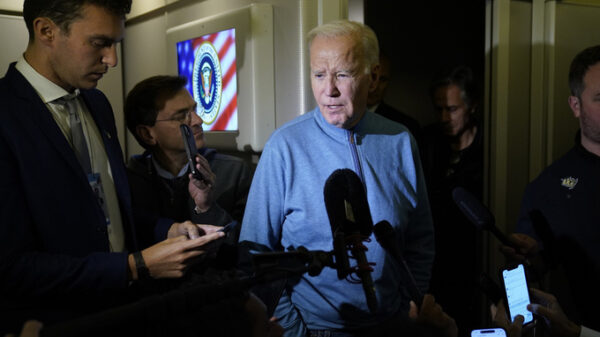
Flying back to Washington, Trump said some leaders support the idea but require parliamentary approval before formally joining, naming Italy and Poland as examples. He added that invitations had gone out only days earlier and portrayed the early response as encouraging.
Unclear mandate and leadership questions
The charter governing the Board of Peace has not been released publicly, raising questions among diplomats and analysts about its authority, scope, and longevity. Trump suggested he could remain chairman even after leaving office, saying the role could theoretically be held “for life,” though he said he had not decided whether he would want to do so.
Trump has alternately described the board as a partner to the United Nations and as a potential alternative to some of its functions, adding to confusion about how the two institutions would coexist.
Diplomats familiar with the discussions say some governments agreed only provisionally, tying their participation strictly to the Gaza ceasefire framework already endorsed by the U.N. Security Council. Others have expressed concern that parts of the proposed charter conflict with established international norms.
Controversial invitations and geopolitical tension
The inclusion of authoritarian leaders among the invitees has further complicated the initiative. Britain’s foreign secretary publicly questioned whether Russian President Vladimir Putin should be involved in a peace-focused body while Russia’s war in Ukraine continues.
The Kremlin said Moscow is still consulting with partners before deciding whether to join. Putin has floated a proposal to contribute $1 billion to the board for humanitarian purposes, potentially using Russian assets frozen by the United States. Trump said he would support such a contribution if it involved Russian funds.
Gaza, Ukraine, and Iran loom large
Trump tied the Board of Peace closely to his broader foreign policy agenda. At Davos, he highlighted plans for Gaza’s postwar governance and reconstruction, though Israeli officials have yet to confirm key elements, including the reopening of the Rafah border crossing.
He also met privately with Ukrainian President Volodymyr Zelenskyy, expressing cautious optimism but acknowledging that negotiations to end the war with Russia remain stalled over longstanding issues, particularly territorial disputes. U.S. envoys and Trump’s son-in-law, Jared Kushner, were simultaneously engaged in talks in Moscow, while trilateral U.S.-Ukraine-Russia discussions were set to begin in the United Arab Emirates.
Iran also featured prominently in Trump’s remarks. He reiterated threats of economic penalties against countries doing business with Tehran and confirmed that U.S. naval forces were being repositioned in the region, even as he said Washington was holding off on new military strikes for now.
An ambitious idea with uncertain footing
Trump’s Board of Peace represents one of the most sweeping diplomatic initiatives of his presidency, but its future remains uncertain. With major allies hesitant, unanswered questions about governance, and skepticism from diplomats and experts, the board’s ability to function as a credible global peace broker will depend on whether it can translate bold rhetoric into broad international support.

For now, the initiative stands as a high-profile experiment—one that reflects Trump’s preference for unconventional diplomacy, but whose ultimate reach and relevance are still very much in question.