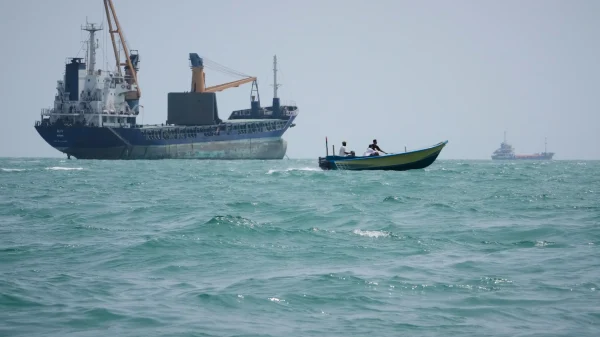
The strategic Strait of Hormuz has become the latest flashpoint in the ongoing confrontation between the United States and Iran, with both governments asserting authority over one of the world’s most important maritime trade routes. The competing claims have intensified geopolitical tensions, disrupted commercial shipping, and fueled uncertainty in global energy markets.
Stretching between Iran and Oman, the Strait of Hormuz serves as a vital gateway for the transportation of crude oil and liquefied natural gas from the Middle East to international markets. Any disruption in the waterway has immediate consequences for global trade and energy prices.
US and Iran Both Assert Control
US President Donald Trump announced on Monday that the United States would assume responsibility for protecting navigation through the Strait of Hormuz. He also declared plans to impose transit fees on commercial vessels, arguing that the charges would cover the costs of maintaining security in the increasingly volatile region.
Iran, however, firmly rejected the US position. The country’s Islamic Revolutionary Guard Corps (IRGC) maintains that Tehran has the authority to regulate maritime traffic through the strait and has accused Washington of interfering in regional affairs.
The competing declarations have significantly increased concerns about freedom of navigation in one of the world’s busiest shipping corridors.
International Law and Navigation Rights
Under the 1982 United Nations Convention on the Law of the Sea (UNCLOS), international straits are generally open to ships from all nations, ensuring uninterrupted passage for commercial and civilian vessels.
Although neither the United States nor Iran has formally ratified the convention, many legal experts argue that the principle of free navigation has become part of customary international law and is widely recognized across the global community.
Legal analysts note that no single country can legally claim exclusive ownership of an international waterway such as the Strait of Hormuz.
Shipping Traffic Drops Sharply
The conflict has already had a significant impact on maritime commerce.
According to maritime tracking data, vessel movements through the Strait of Hormuz have fallen dramatically in recent days. Daily crossings reportedly dropped from around 130 ships before the conflict to only a small fraction of that number during the latest escalation.
Shipping companies have become increasingly cautious due to security risks, including military activity, attacks on vessels, and uncertainty over safe navigation routes.
Iran Introduces New Shipping Requirements
Following an interim ceasefire announced last month, Iran introduced new procedures for commercial vessels entering the strait.
Authorities instructed ships to register with a newly established maritime administration before transit and requested that vessels use routes closer to Iran’s coastline instead of the southern passage near Oman.
Security officials have also warned of hazardous conditions in parts of the central waterway, further complicating international shipping operations.
Several maritime security organizations have reported attacks on vessels operating near the Omani side of the strait, adding to concerns among global shipping companies.


Disagreement Over Ceasefire Terms
Washington and Tehran continue to interpret the ceasefire agreement differently.
US officials argue that the temporary agreement was intended to restore unrestricted navigation while broader negotiations continue.
Iranian authorities, however, insist that the agreement permits Tehran to oversee maritime operations and establish operational rules for commercial traffic during the interim period.
The differing interpretations have become another source of friction between the two countries.
US Proposal for Transit Fees Sparks Debate
The US administration’s proposal to introduce a 20% transit fee for commercial cargo passing through the Strait of Hormuz has generated widespread discussion among legal experts and the international shipping industry.
Specialists in maritime law acknowledge that certain service-related fees may be permissible if they directly reflect services such as pilotage or navigation assistance. However, imposing broad tolls simply for passage through an international strait could conflict with long-standing international norms supporting freedom of navigation.
The International Maritime Organization (IMO), the United Nations agency responsible for global shipping safety, has indicated that it is reviewing the proposal while reaffirming its longstanding position against general transit tolls in international waterways.
Global Markets Watching Closely
The ongoing dispute has placed additional pressure on global energy markets, with investors closely monitoring developments in the Gulf region.
Because a substantial share of the world’s oil and natural gas exports passes through the Strait of Hormuz, prolonged instability could affect fuel supplies, shipping costs, insurance premiums, and international trade.
As diplomatic tensions remain high, governments, shipping companies, and energy markets continue to watch for signs of either further escalation or renewed negotiations that could restore stability to one of the world’s most strategically important maritime routes.