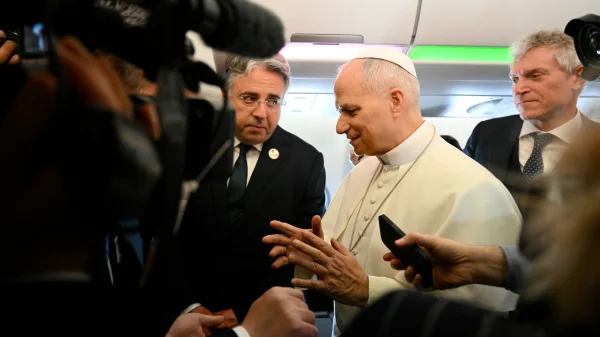












In a powerful appeal for unity amid deep political and social turmoil, Pope Leo XIV used his first full day in Lebanon on Monday to champion the country’s long-standing tradition of interfaith coexistence. Standing alongside Lebanon’s Christian and Muslim leaders in Beirut’s Martyrs’ Square, the pontiff called for “the divine gift of peace” and urged the nation to remain a regional symbol of tolerance.
Thousands braved steady rain to greet the pope as he traveled through the capital, with crowds lining the streets, waving flags, and showering his motorcade with flower petals. Billboards bearing his image decorated Beirut’s main arteries, signaling the anticipation surrounding the historic visit.
A Message for a Troubled Nation
Pope Leo XIV’s visit comes at a delicate moment for Lebanon, which continues to grapple with economic collapse, political paralysis, and the lingering trauma of the 2020 Beirut port explosion. Meanwhile, renewed conflict involving Israel and Hezbollah has heightened fear of a wider regional escalation.
Addressing these tensions, the pope urged Lebanon’s religious leaders to serve as mediators, saying the nation can still be a “powerful reminder that unity, reconciliation, and peace are possible,” even in times of deep division.
Sunni Grand Mufti Abdul-Latif Derian and senior Shiite cleric Ali al-Khatib both welcomed the pope’s call for peace, with al-Khatib appealing for help in ending continuing Israeli strikes. Religious figures from Lebanon’s diverse Christian, Sunni, Shiite, and Druze communities later planted an olive tree together as a symbol of shared hope.
Pilgrimage to a Beloved Saint
Earlier in the day, the pope visited the Monastery of Saint Maroun in Annaya, where he prayed at the tomb of St. Charbel Makhlouf — a revered figure among both Christians and Muslims. Despite heavy rain, crowds gathered on the hillside to welcome the pontiff, who offered a ceremonial lamp as a gesture of spiritual solidarity.
The visit underscored the significance of Lebanon’s Christian community, which remains the largest in the Middle East by proportion. Pope Leo encouraged young people not to abandon the country, urging them instead to help rebuild and preserve Lebanon’s pluralistic identity.
A Vital Christian Presence in the Middle East
Christians today make up roughly one-third of Lebanon’s population. Their role is constitutionally protected through a power-sharing system that assigns the presidency to a Maronite Christian — a unique arrangement in the Arab world.
As many Lebanese continue to emigrate due to economic hardship, church leaders emphasized the importance of maintaining a strong Christian presence. Diaspora groups traveled from around the world to join the pope, reinforcing a shared commitment to Lebanon’s future.
“We must live in this land as brothers,” said one pilgrim outside the monastery. “No one can uproot us from this country.”
A Visit Filled With Hope
Pope Leo XIV concluded his day with a rally of Lebanese youth in Bkerki, seat of the Maronite Church. The emotional gathering reflected widespread hope that the pontiff’s visit might inspire national renewal at a moment of crisis.
“We are so proud,” said Nawal Ghossein, one of the participants. “This is an unforgettable moment.”
As Lebanon faces the challenges ahead, the pope’s message was clear: the country’s legacy of coexistence must remain a guiding light for the region.