





















MUMBAI — Japan’s largest property developers are stepping up their presence in India, betting on soaring office rents, competitive construction costs, and the momentum of one of the world’s fastest-growing major economies. Industry executives say more Japanese firms are preparing to enter the market, signalling the strongest wave of interest yet from Japan’s real estate sector.
Fresh Capital Flows Into Indian Projects
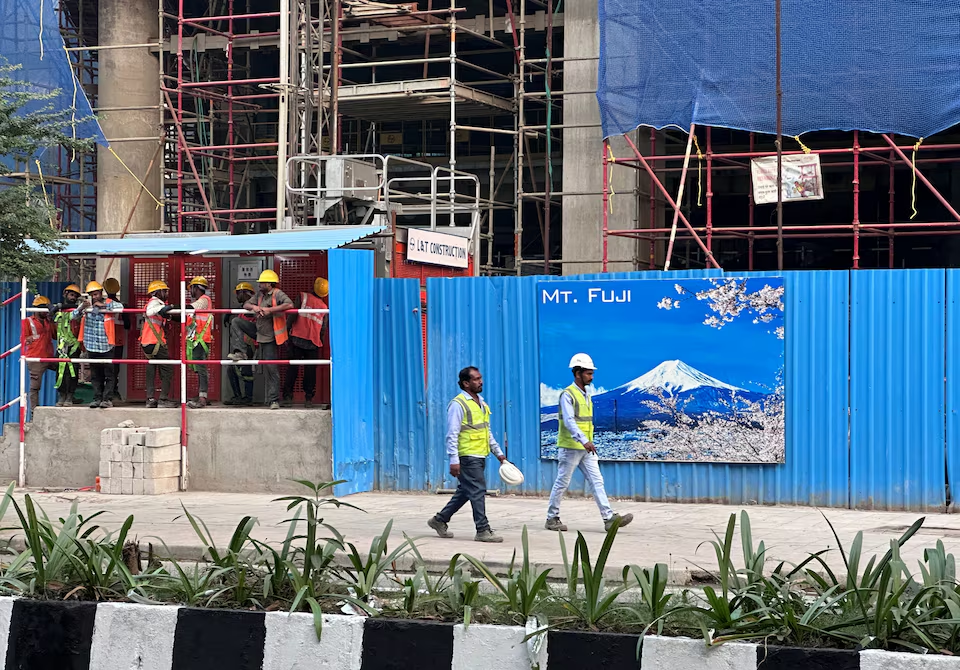
Mitsui Fudosan, Japan’s biggest real estate developer, has been expanding steadily since entering India in 2020 through a partnership with RMZ Real Estate to build a commercial complex in Bengaluru. According to people familiar with the matter, the company is considering fresh investments worth 30–35 billion yen ($190–$225 million) or more, exploring potential projects with RMZ and other developers. Senior executives from Mitsui visited Mumbai and the Delhi region last month to assess new opportunities.
While both firms declined to comment on upcoming investments, RMZ Real Estate CEO Avnish Singh noted that Japanese confidence in India has grown significantly: “The floodgates can open, and have opened,” he said, highlighting the trust built between Japanese developers and local partners in recent years.
Sumitomo Expands Its Mumbai Footprint
Sumitomo Realty & Development, Japan’s third-largest developer, has already committed $6.5 billion across five major projects in Mumbai and continues to scout for additional land parcels. One focus area is the vicinity surrounding the soon-to-open Navi Mumbai airport, where the company sees room for large-scale development. Industry sources say Sumitomo aims to introduce advanced building technologies not yet widely used in India, such as steel-frame structures capable of delivering large, pillar-free office floors.
The company expects premium rents—potentially 30–40% higher than typical rates in the Bandra Kurla Complex—driven by innovative designs and strong demand. JPMorgan is among the major global firms expected to occupy space in one of Sumitomo’s flagship developments.
A Competitive Market Attracting Global Heavyweights
Japanese developers join a crowded field of international investors. U.S. private equity giant Blackstone remains India’s largest commercial landlord, with real estate making up around half of its $50 billion investment portfolio in the country. While global investors often prefer acquiring completed assets to avoid construction delays, Japanese firms stand out for their willingness to take on development risk.
“Japanese investors are comfortable rolling up their sleeves,” said Singh, noting that India’s improved regulatory framework has made development more attractive than in previous decades.
The Appeal: Low Costs, High Returns
India’s cost advantage is one of the biggest draws. Labour remains inexpensive, with electricians and plumbers costing roughly $2 per hour. Meanwhile, construction expenses for premium office buildings are significantly lower than in global hubs:
- New York: ~$8,000 per sq. m
- London: ~$5,300 per sq. m
- Tokyo: ~$4,000 per sq. m
- Mumbai: ~$656 per sq. m
These lower costs pair with rapidly rising commercial rents. Mumbai’s Bandra Kurla Complex recorded a 14.2% increase in prime office rents in the third quarter, the highest in the Asia-Pacific region. Delhi NCR and Bengaluru also ranked among the top performers, supported by India’s robust economic growth averaging 8% over the past three fiscal years.
Growing Japanese Interest in Overseas Real Estate
A survey by the Sumitomo Mitsui Trust Research Institute shows Japanese companies and investment funds increased their overseas real estate spending by 20% this year. While the U.S. and Australia remain top destinations, interest in India has surged, with 41% of surveyed firms expressing intent to invest—an increase of six percentage points from last year.
Daibiru Corp, another Japanese entrant, has begun acquiring office properties in India and is now evaluating opportunities in residential projects and data centres, according to executives.
As India continues to modernise its infrastructure and streamline development processes, analysts expect Japanese participation in the real estate sector to grow even more widespread in the coming years.