














HONG KONG — China’s largest state-owned defence companies saw revenues fall sharply last year as an extensive anti-corruption campaign slowed procurement, delayed major weapons programmes, and cast uncertainty over the pace of the country’s military modernisation, according to a new report from the Stockholm International Peace Research Institute (SIPRI).
The findings stand in stark contrast to global industry trends. While wars in Ukraine and Gaza, along with rising geopolitical tensions, have fuelled growth for major defence contractors worldwide, China’s leading firms experienced a significant downturn.
Corruption Purge Disrupts Contracts
SIPRI researchers say a wave of corruption allegations inside China’s defence establishment triggered widespread contract postponements and cancellations throughout 2024. This follows an intensified crackdown ordered by President Xi Jinping, which reached new heights last year when the elite Rocket Force came under scrutiny.
In October, eight senior generals — including He Weidong, the military’s second-highest-ranking officer — were expelled from the Communist Party on graft charges. Diplomats and analysts say the depth and reach of the investigation have left foreign governments assessing how the internal upheaval may affect China’s long-term military ambitions.
Chinese Revenues Drop as Global Sales Surge
The report shows revenues at China’s major arms producers fell by 10%, making Asia-Oceania the only region where top defence firms posted a decline. By comparison, Japanese defence companies saw revenues rise 40%, German firms 36%, and U.S. companies nearly 4%.
Globally, the world’s top 100 arms manufacturers achieved a record $679 billion in revenue last year, a 5.9% increase overall.
Impact on China’s Modernisation Plans
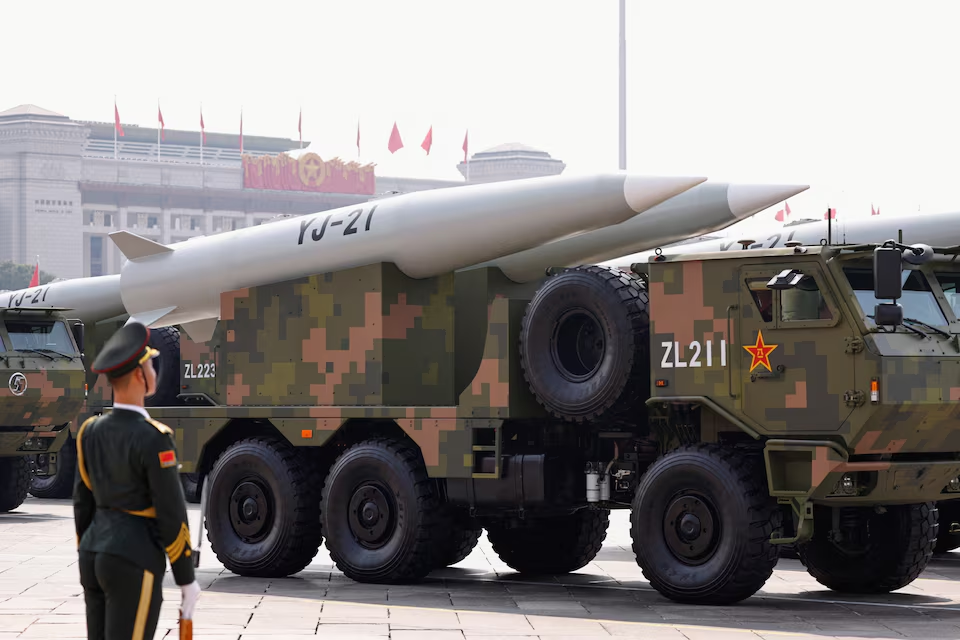
Despite three decades of rising defence spending and the rapid expansion of its naval and missile forces, China’s military-industrial base faced notable strain. SIPRI found that leading state-owned enterprises — including aviation giant AVIC, land-systems producer Norinco, and missile manufacturer CASC — all recorded revenue declines. Norinco suffered the largest drop, sliding 31% to $14 billion.
Personnel reshuffles linked to corruption probes prompted reviews and delays across multiple projects, from missile development to aircraft production. SIPRI warned that schedules for advanced systems within the Rocket Force — responsible for ballistic, hypersonic, and cruise missiles — could face exposure, alongside key aerospace and cyber capabilities.
Long-Term Modernisation Still Expected to Continue
While the current disruption has raised questions about Beijing’s ability to meet its goal of achieving major war-fighting readiness by the PLA’s 100th anniversary in 2027, SIPRI analysts believe China’s broader military modernisation drive remains intact. Continued investment and strong political backing suggest the long-term trajectory will resume, though with higher costs, tighter oversight, and further short-term delays.
China’s defence ministry and the companies named in the report did not respond to requests for comment.