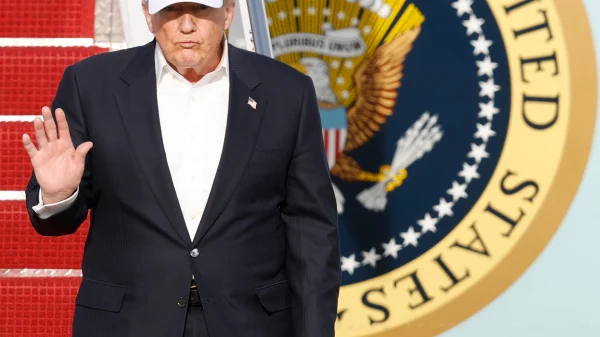

















A call by U.S. President Donald Trump for major global powers to send naval forces to safeguard shipping through the strategically vital Strait of Hormuz has so far received no firm commitments from foreign governments, highlighting growing caution as tensions intensify in the Middle East.
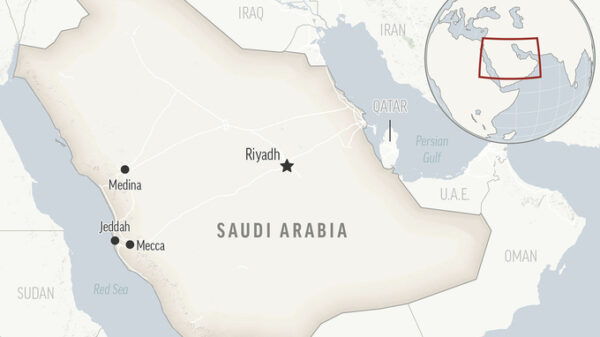
The appeal comes as global oil markets face severe volatility due to the ongoing war involving Iran, Israel, and the United States. Roughly one-fifth of the world’s crude oil exports typically pass through the narrow maritime corridor connecting the Persian Gulf to international waters.
Diplomatic Outreach for Naval Protection
Washington has urged countries including China, France, Japan, South Korea, and the United Kingdom to participate in a multinational effort aimed at ensuring the safety of commercial shipping through the waterway.
U.S. Energy Secretary Chris Wright said discussions with several governments are underway, though he did not specify which nations may participate. He expressed optimism that Beijing could contribute to efforts to stabilize maritime trade routes and help restore normal shipping operations.
However, responses from potential partners have so far been cautious.
The United Kingdom signaled that discussions with allies are ongoing but emphasized that diplomatic efforts to end the conflict would provide the most effective solution. Meanwhile, South Korea stated it is closely monitoring the situation and consulting with Washington before deciding on any involvement.
Expectations are also rising that the issue could be addressed during an upcoming meeting between President Trump and Japanese Prime Minister Sanae Takaichi at the White House later this week.
Iran Signals Conditional Passage for Ships
Tehran maintains that the strait remains open to most international shipping but warned that access could be restricted for the United States and its allies.
Iranian Foreign Minister Abbas Araghchi said several countries have contacted Tehran requesting safe passage for their vessels. According to him, some international ships have already been allowed to transit the strait, although he did not provide specific details.
Araghchi also ruled out negotiations with Washington to end the war, accusing the United States and Israel of initiating the conflict through coordinated military operations earlier this year.
Rising Military Tensions Across the Gulf
The regional conflict has triggered a surge in missile and drone attacks across Gulf states. Iran recently warned residents to evacuate major ports in the United Arab Emirates, marking one of the strongest threats against a neighboring country since hostilities began.
Authorities in the UAE, Saudi Arabia, and Bahrain reported intercepting incoming projectiles, while Iran accused the United States of launching strikes on its key oil facilities from Emirati territory—an allegation both Washington and Abu Dhabi deny.
Iran has warned that if its oil infrastructure continues to be targeted, it may retaliate against what it calls U.S.-linked energy and economic installations across the region.
Global Oil Markets Brace for Impact
The conflict has sent shockwaves through global energy markets. To stabilize prices, the International Energy Agency announced the release of nearly 412 million barrels of emergency oil reserves—the largest coordinated stock release in history.
Asian member states are expected to release reserves immediately, while Europe and the Americas plan to begin releasing supplies by the end of March.

Growing Humanitarian Crisis
The war has already caused significant casualties and displacement across multiple countries. International aid groups report more than 1,300 deaths in Iran alone, including hundreds of women and children.
Missile strikes have also killed civilians in Gulf nations and Israel, while clashes between Israel and the Iran-backed group Hezbollah have expanded fighting into Lebanon.
Lebanon is facing a severe humanitarian crisis, with over 800,000 people displaced within days of intensified fighting. Many families in Beirut and surrounding areas are struggling to find shelter as rain and damaged infrastructure worsen living conditions.
Ongoing Strikes Between Iran and Israel
Military exchanges between Israel and Iran continued over the weekend. Iranian missile attacks targeted central Israeli cities, including the metropolitan area of Tel Aviv, causing damage to residential buildings and infrastructure.
Israeli officials say some Iranian attacks involve cluster munitions designed to overwhelm air defense systems, resulting in multiple impact sites across urban areas.
As the conflict spreads across the region, international observers warn that any disruption to the Strait of Hormuz could trigger wider economic instability and threaten global energy supplies.