
























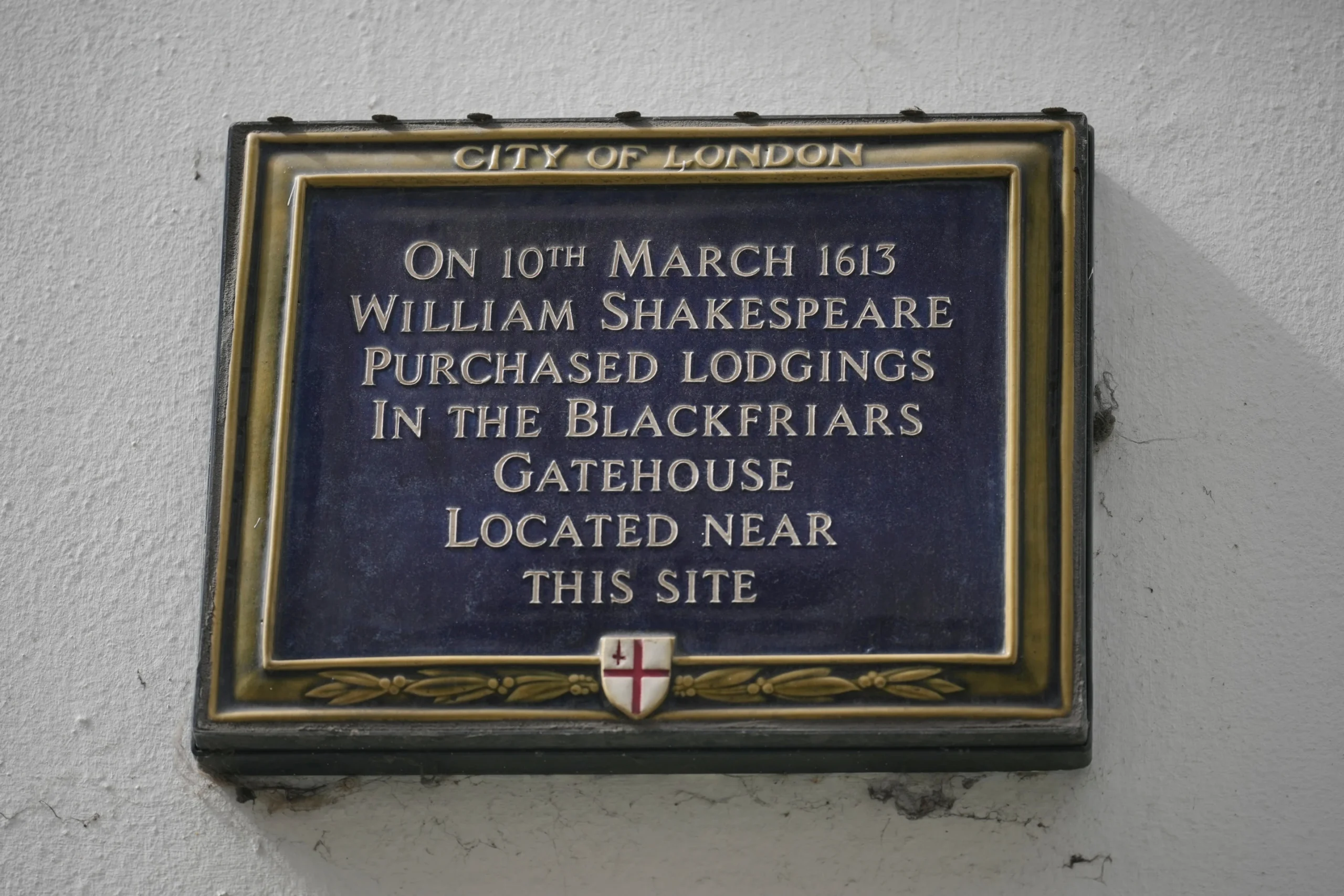
A remarkable archival discovery has finally pinpointed the precise location of the only property ever purchased in London by playwright William Shakespeare, shedding new light on his life in the city where he rose to literary fame.
Researchers say a newly examined 17th-century map has resolved a centuries-old mystery surrounding Shakespeare’s residence near the historic Blackfriars area, offering fresh insight into how closely he lived to the theatrical world that shaped his career.
Historic Map Solves Centuries-Old Puzzle
The breakthrough came after a scholar uncovered the rare document while researching materials at London Archives. The map details the Blackfriars precinct in remarkable clarity, including the exact structure believed to have been Shakespeare’s London home.
Until now, historians only knew that Shakespeare acquired property in 1613 near the Blackfriars playhouse, but the building’s exact location had never been confirmed. A commemorative plaque placed in the 19th century only suggested it was somewhere “near this site,” leaving its true position uncertain for generations.
Detailed Layout of Shakespeare’s Residence
The newly studied plan reveals a substantial L-shaped house converted from a former medieval monastery complex. It also shows the gatehouse and surrounding structures, providing the clearest visual reconstruction yet of Shakespeare’s urban residence.
Experts from King’s College London, who announced the discovery, say the property stood within the former grounds of a 13th-century Dominican friary. Following the dissolution of monasteries under King Henry VIII, the area was redeveloped into a mix of elite housing and entertainment venues.
Nearby stood the Blackfriars Theatre, a venue in which Shakespeare held partial ownership, placing him at the heart of London’s thriving theatrical district.
Shakespeare’s Life in the Heart of Theatre District
Scholars believe the location strengthens the case that Shakespeare was more deeply embedded in London life than previously assumed. The property’s proximity to the theatre—just minutes away on foot—suggests he may have spent extended periods in the capital during the final phase of his career.
Experts note that the Blackfriars area at the time was a unique blend of high-status residents, court officials, and theatre professionals. While considered fashionable, it also attracted criticism due to its association with performance venues and taverns.
The contrast reflects Shakespeare’s own position in society: financially successful yet closely tied to the evolving, and sometimes controversial, world of public theatre.
Possible Link to His Final Works
Researchers also suggest that Shakespeare may have written some of his last plays while based in the property, including Henry VIII and The Two Noble Kinsmen, both co-authored with John Fletcher. However, it remains unclear whether he lived there permanently or used it primarily as an investment property.
Property Passed Through Family Before Fire Destroyed It
After Shakespeare’s death in 1616 in Stratford-upon-Avon, the London residence was inherited by his daughter Susanna and remained in the family for decades. Archival records show it was eventually sold by a descendant in the mid-17th century.
Tragically, the building was destroyed in the Great Fire of London in 1666, which swept through large sections of the city and erased much of its medieval architecture.
Modern-Day Traces of Shakespeare’s London
Although the original structure no longer exists, fragments of the medieval Blackfriars complex still remain within London’s modern financial district. Place names such as Playhouse Yard preserve echoes of the area’s theatrical heritage.
Across the street, a long-standing pub—once recorded on early maps as the “Sign of the Cock”—is believed to have stood near where Shakespeare’s house once stood. Today, it serves as one of the few remaining cultural links to the playwright’s London environment.

A New Perspective on Shakespeare’s Urban Life
Shakespeare scholars say the discovery reshapes understanding of the writer’s relationship with London, highlighting how central the city was to his professional and personal life.
According to researchers at Shakespeare’s Globe, the finding reinforces the idea that Shakespeare was not just a visitor to London’s theatre scene, but a deeply rooted figure within its social and artistic fabric.