

















BANGKOK — Financial markets across Asia and the United States opened sharply lower Monday after coordinated U.S. and Israeli military strikes on Iran heightened fears of a wider Middle East conflict. Oil prices spiked while investors rushed toward traditional safe-haven assets, reflecting deep concerns over global energy supplies and economic stability.
U.S. Futures and Asian Stocks Retreat
Futures tied to the S&P 500 and Dow Jones Industrial Average dropped more than 1% in early trading before trimming losses to around 0.8% by mid-morning in Bangkok. The pullback followed Friday’s declines on Wall Street, where the S&P 500 posted only its second monthly loss in the past 10 months.
Across Asia, markets reacted swiftly:
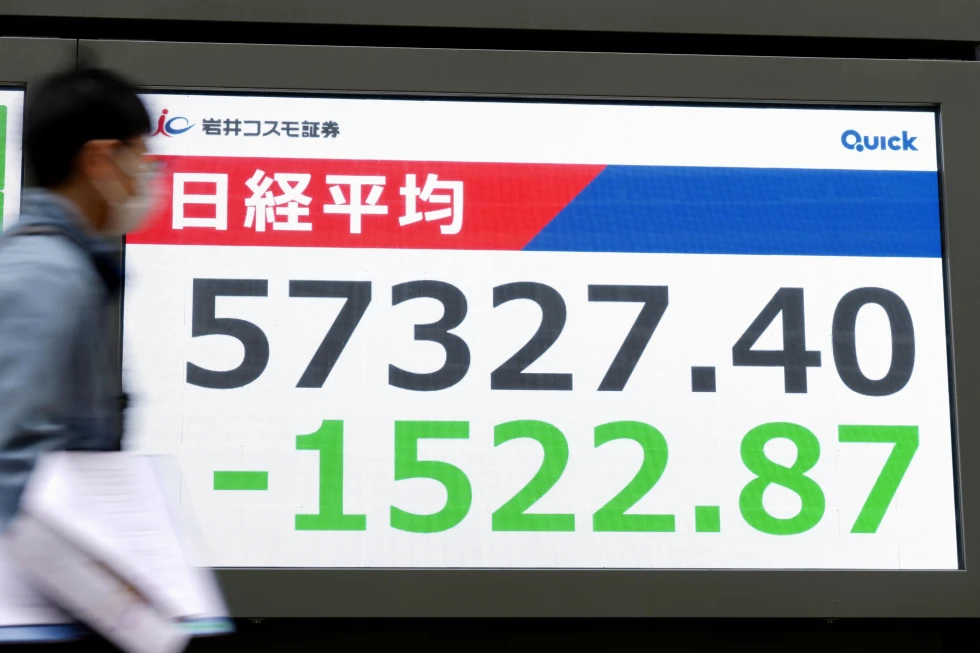
- Japan’s Nikkei 225 fell more than 2% at the open before recovering slightly to close midday trading down 1.5% at 57,981.54.
- Hong Kong’s Hang Seng Index lost 1.6% to 26,215.91.
- The Shanghai Composite Index was little changed, edging flat at 4,163.01.
- Taiwan’s benchmark slipped 0.6%, Singapore’s market declined 1.9%, and Thailand’s SET index dropped 2.1%.
- Australia’s S&P/ASX 200 shed 0.3% to 9,173.50.
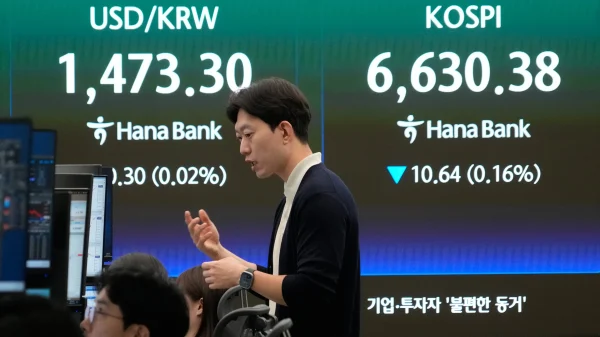
Markets in South Korea remained closed for a public holiday.
Oil Prices Jump on Supply Fears
Energy markets saw the most dramatic reaction. U.S. benchmark crude initially surged about 8% before easing to trade 5.9% higher at $71 per barrel. Brent crude climbed 6.2% to $77.38 per barrel.
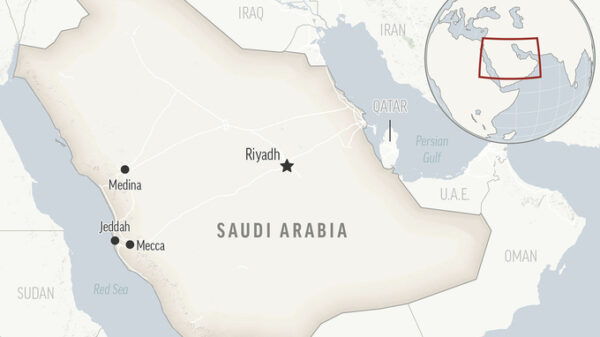
Traders are pricing in the risk of supply disruptions from Iran and neighboring producers, particularly as attacks were reported near shipping routes including the strategically vital Strait of Hormuz. Roughly one-fifth of the world’s oil and liquefied natural gas shipments pass through the narrow waterway linking the Persian Gulf to global markets.
Iran exports approximately 1.6 million barrels of crude oil daily, with China as a primary buyer. Any sustained interruption could force importers to seek alternative suppliers, potentially driving prices higher and intensifying inflationary pressures worldwide.
Analysts warn that a prolonged conflict could push up fuel costs globally, increasing production expenses across industries and straining already fragile economies.
Safe-Haven Assets Gain
Investors sought shelter in traditional safe havens. Gold prices jumped 2.4% to about $5,371 per ounce. U.S. Treasury yields declined as bond prices rose, signaling demand for lower-risk investments.
Currency markets also reflected caution. The U.S. dollar edged up slightly against the Japanese yen, while the euro dipped modestly against the dollar.
Inflation Concerns Add to Volatility
The geopolitical turmoil compounds existing worries over inflation and interest rates. A report released Friday showed U.S. wholesale inflation at 2.9% last month, significantly higher than economists’ expectations of 1.6%. Elevated inflation may prompt the Federal Reserve to delay interest rate cuts, potentially weighing further on equity markets.
Market strategists note that while the possibility of military action had been anticipated following a buildup of U.S. forces in the region, the scale and timing of the strikes have injected fresh uncertainty.
For now, global investors are closely monitoring developments in the Middle East, particularly any signs of disruption to oil flows or escalation that could deepen economic fallout.